
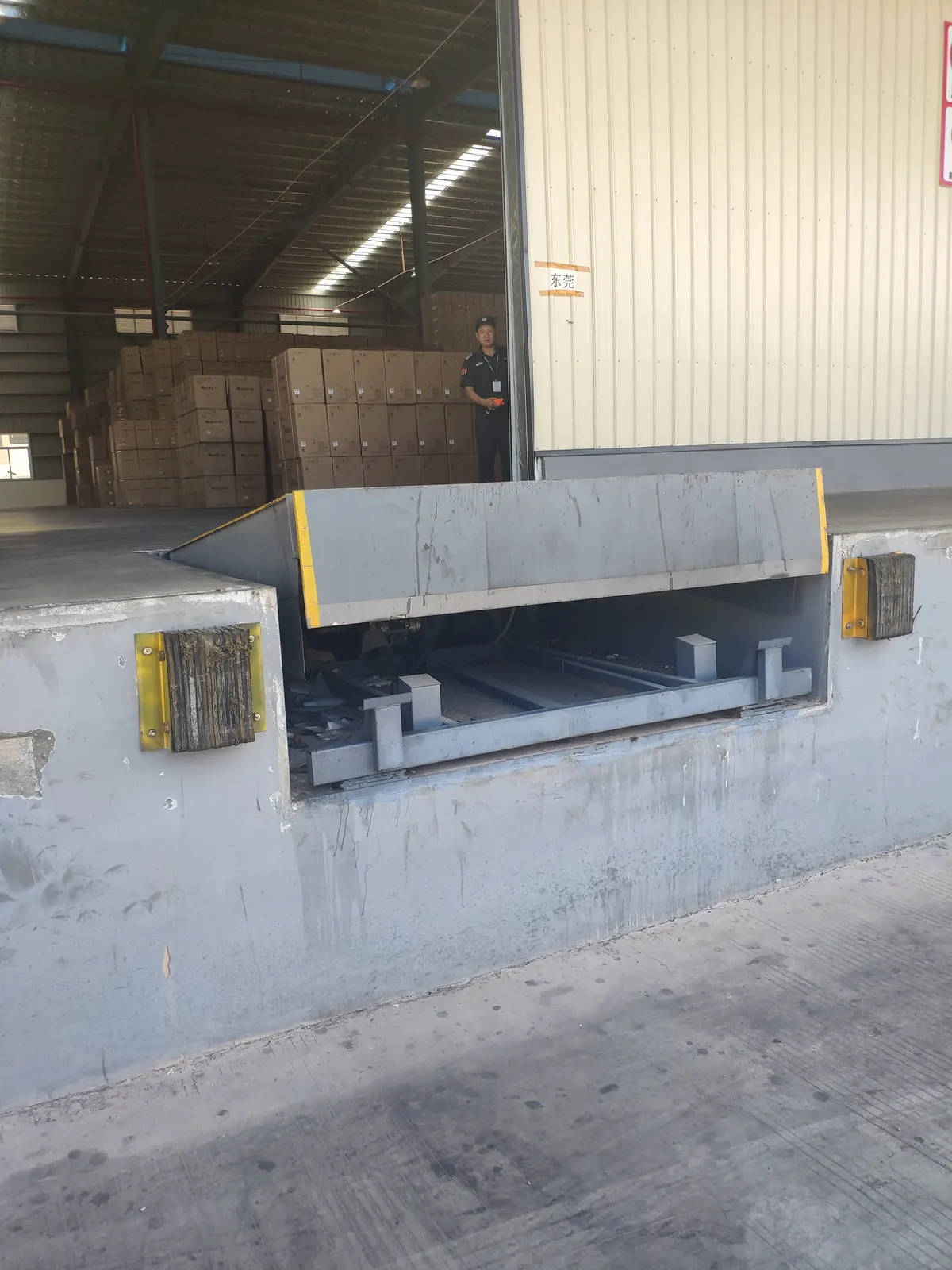
At a loading dock, the warehouse floor and trailer bed are rarely at the same height. A hydraulic dock leveler bridges that difference. Its main platform, called the deck, rises or lowers to meet the trailer bed, while a hinged lip extends onto the trailer floor to complete the connection. That is how a dock leveler works in its simplest form: the deck manages the height difference, and the lip completes the path for moving goods between the building and the vehicle.
How the Dock-to-Trailer Bridge Works
The deck is hinged at its rear edge on the dock side. At its front edge, the lip swings out over the trailer floor. Once the lip rests on the trailer, the deck and lip form the sloped transition between the two surfaces.
This arrangement matters because the truck bed is the moving side of the loading connection. The dock floor stays in one place, while vehicle height can differ from the dock level. The leveler provides a movable bridge rather than treating the dock floor and trailer bed as one fixed plane.
The bridge has two connected jobs. It closes the horizontal space at the dock door, and it creates a usable path when the trailer floor sits above or below the warehouse floor. The deck provides the ramp portion of that path. The lip extends the path far enough to meet the trailer side. Looking at those jobs separately makes it easier to see why the leveler needs both a moving deck and a moving front edge.
The Main Parts Behind the Movement
The deck and lip form the visible bridge. The components beneath the deck make that bridge move.
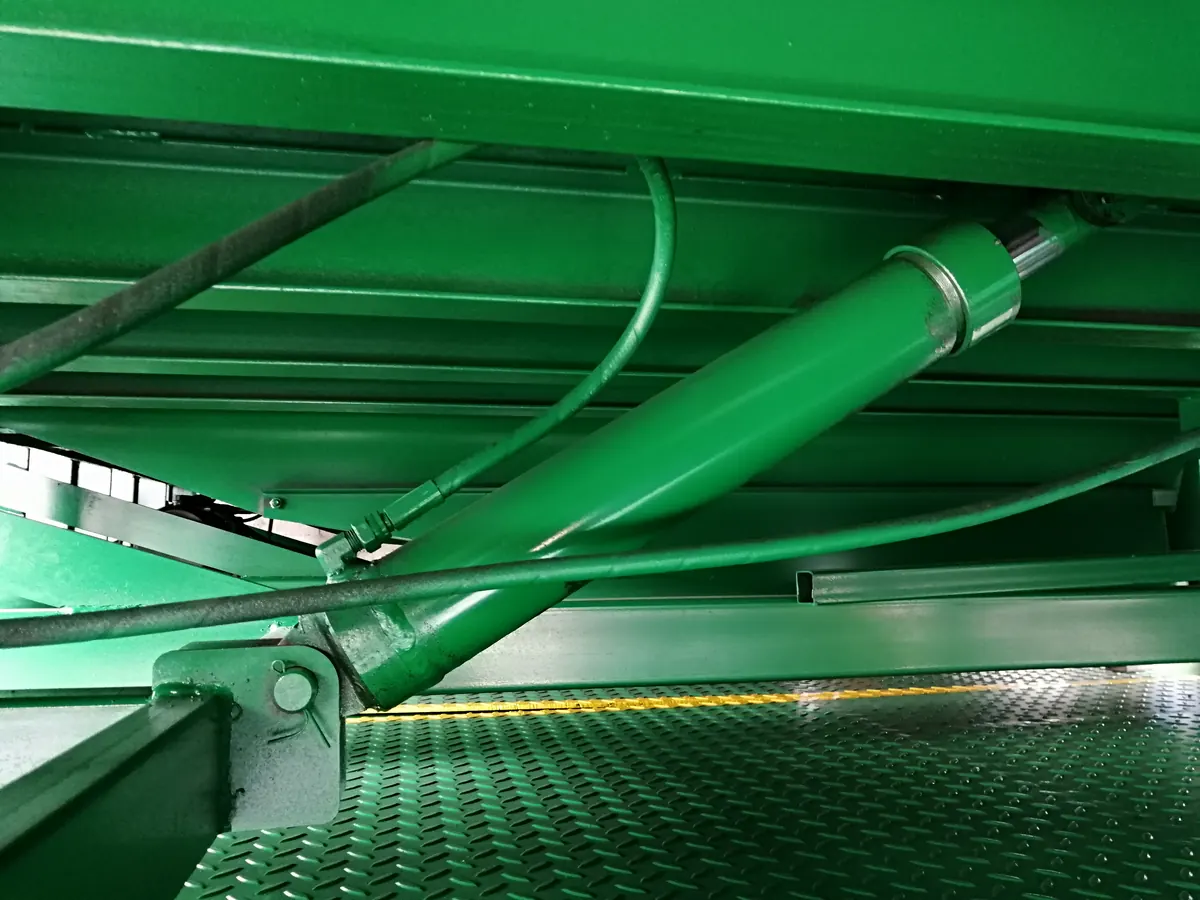
The frame supports the leveler within the dock structure. The deck pivots from this dock-side structure, and the lip pivots from the front of the deck. A hydraulic power unit provides the power source for the movement. Hydraulic cylinders convert that power into the motion that raises or lowers the deck and, in many hydraulic configurations, positions the lip.
Public hydraulic dock-leveler assemblies show that a power pack, a deck-lift cylinder, and a lip cylinder may be arranged as separate components. That arrangement should be read as an example of hydraulic design, not as a specification for every dock leveler. Cylinder number, placement, and lip design can differ by configuration.
The power unit is the source of hydraulic movement. In a typical powered arrangement, it combines a motor, pump, and hydraulic-fluid reservoir so that fluid can be directed to a cylinder. The cylinder then changes hydraulic pressure into linear movement. At the dock, that movement is transferred into the upward or downward motion of the deck, or into the motion of the lip. This is why the hydraulic system belongs in the explanation even though the deck and lip are the parts a reader sees from above.
How Hydraulic Motion Moves the Deck and Lip
In a hydraulic dock leveler, the lift cylinder gives the deck controlled vertical movement from its stored position. As the deck rises, the lip can move into position to reach the trailer floor.
For a typical hydraulic pit leveler, one hydraulic cylinder raises and lowers the deck, while another cylinder is commonly used for the lip. This separation helps explain why the deck and lip can perform different parts of the bridging motion: one forms the ramp, and the other completes the overlap with the trailer.
The deck does not need to become perfectly flat with the warehouse floor to do its job. Its purpose is to create the transition from the fixed dock elevation to the trailer floor. The lip has a narrower role: it provides the final bearing surface at the vehicle side. Separating those roles helps readers avoid treating the leveler as a single rigid plate. It is a linked assembly whose visible surfaces move for different reasons.
A Typical Dock-to-Trailer Bridging Cycle
The following sequence describes the common motion behind a hydraulic dock leveler.
First, the deck moves upward from its stored position. Raising the deck gives the lip room to move out from the front edge. The lip then reaches over the trailer floor.
Next, the deck lowers until the lip rests on the trailer bed. The deck is no longer simply a level surface at the warehouse floor; it becomes the ramp section of the bridge. The lip provides the overlap at the trailer side.
During loading or unloading, the leveler remains the connection between the dock and the trailer. When the loading connection is no longer needed, it returns to its stored relationship with the dock floor.
This sequence also explains why the lip is not simply an extension of the warehouse floor. It must first move clear of its stored position, then reach the trailer side before the deck settles into the bridging position. The deck supplies the change in elevation, while the lip supplies the contact at the far end. Together, they turn motion beneath the deck into a continuous travel path above it.
Why the Exact Cycle Can Differ by Model and Site
The same hydraulic principle can appear in different equipment configurations. A leveler may differ in deck construction, lip arrangement, cylinder layout, control design, storage position, or the way it is integrated into a loading dock. Those differences affect how the equipment is configured for a particular dock and trailer environment.
For that reason, a general explanation of hydraulic operation should not be used as a model-specific operating guide. The article explains what the deck, lip, and hydraulic motion do together. It does not establish the control logic, component layout, load rating, installation design, or operating requirements for a particular unit.
For an early project discussion, the useful next questions are about the loading path: where goods move, which vehicles use the dock, and how the dock and trailer surfaces need to connect. Those project conditions determine which product information is relevant after the basic operating principle is clear.
Understanding the principle also makes later product conversations more focused. Instead of beginning with a generic question about a hydraulic unit, a project team can distinguish between the bridge it needs to create, the dock conditions it must work within, and the equipment details that must be defined for that application. Those are separate questions, even though they all relate to the same loading position.
Learn More About Dock Leveler Options
For product-level information and project discussions, explore dock leveler product information from Weilin Qinli.
Discuss your loading dock requirements with our team.