
Choosing a hydraulic cargo lift is not simply a matter of selecting the highest capacity or lowest price. The right solution must match your cargo, building layout, loading method, operating frequency, safety requirements, and future production needs.
For warehouses, factories, logistics centers, and mezzanine floors, a properly specified cargo lift can improve material flow, reduce manual handling, and make vertical transportation safer. This guide explains the key factors to review before ordering a warehouse cargo lift.
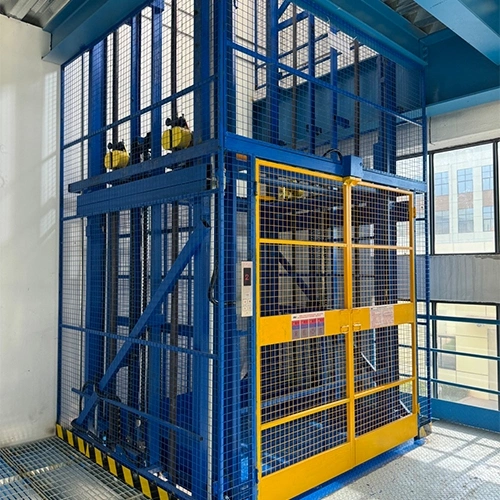
Hydraulic Cargo Lift for Warehouse Material Handling
1. Start with the Cargo, Not the Catalog
The first step is to define exactly what the lift will carry.
Calculate the total operating load, including:
- Products and packaging
- Pallets, cages, or containers
- Pallet trucks or forklifts entering the platform
- Fixtures, bins, or production equipment
- Possible future increases in load
The heaviest individual item is also important. A uniformly distributed 2,000 kg load may be easier to handle than a lighter load concentrated on four forklift wheels.
When requesting a quotation, provide the maximum total load, individual item weight, wheel load, load distribution, and loading equipment. This information helps engineers select the correct platform structure, hydraulic system, guide arrangement, and safety devices.
2. Confirm the Cargo Elevator Dimensions
“Cargo elevator dimensions” should include more than the platform length and width.
Measure the following site conditions:
- Required platform width and depth
- Clear door opening width and height
- Floor-to-floor travel height
- Number of stops and landing positions
- Pit depth and overhead clearance
- Shaft or enclosure dimensions
- Floor opening and structural support
- Available power supply and control-panel location
The platform must be large enough for the cargo and the equipment used to load it. For example, a pallet truck may require additional approach space, while a forklift may need enough clearance to enter, turn, and exit safely.
Do not confuse nominal platform dimensions with usable clear dimensions. Door frames, guardrails, guide rails, and structural components can reduce the available loading area.
3. Select the Right Lift Type for the Application
A hydraulic cargo lift is often suitable for low- to medium-rise goods transportation where high load capacity, smooth movement, and flexible installation are important. However, hydraulic drive is not automatically the best choice for every project.
| Requirement | Hydraulic Cargo Lift | Traction Cargo Lift |
|---|---|---|
| Heavy goods | Well suited | Suitable with proper design |
| Low- or medium-rise travel | Common choice | Also possible |
| High travel height | May require careful design | Often more efficient |
| High speed and frequent cycles | Depends on the system | Often advantageous |
| Installation flexibility | Generally flexible | Depends on shaft and machine layout |
| Main selection factor | Load, layout, and site conditions | Travel, speed, and operating frequency |
For a warehouse cargo lift serving two or three levels, hydraulic equipment may provide a practical balance of capacity and installation flexibility. For a high-rise facility with many stops and continuous traffic, travel speed, energy use, and duty cycle may make another drive system more suitable.
The decision should be based on the complete application rather than the product name alone.
4. Match Speed and Duty Cycle to Real Operations
A faster lift is not always a better lift.
Before choosing the hydraulic power unit, determine:
- How many cycles are required per hour
- How many hours the lift operates each day
- Whether loading is continuous or occasional
- Whether the lift works in a hot, dusty, humid, or cold environment
- How much waiting time is acceptable between cycles
For occasional pallet movement, moderate speed may be sufficient and can help control cost. For production lines or busy distribution centers, the hydraulic system must be designed for repeated operation, heat dissipation, smooth stopping, and reliable control.
The quotation should clearly state rated capacity, lifting speed, lowering speed, duty cycle, power requirements, and recommended maintenance intervals.
5. Treat Safety as Part of the Design
A cargo lift should be designed around safe loading and unloading, not added safety features after installation.
Depending on the application, the system may require:
- Landing gates or doors
- Door and gate interlocks
- Perimeter guarding
- Emergency stop controls
- Overload protection
- Emergency lowering functions
- Hose-rupture or anti-fall protection
- Clearly marked rated load and operating instructions
- Safe maintenance access
The U.S. Bureau of Labor Statistics recorded approximately 261,500 nonfatal injury and illness cases in the transportation and warehousing sector in 2024, with a rate of 4.4 cases per 100 full-time workers. This makes safe material handling an operational priority, not just a compliance issue. BLS data.
For U.S. projects, applicable OSHA requirements should be reviewed, including requirements for rated loads, entrances, guarding, enclosures, and material-hoist operation. OSHA also states that riders are not permitted on material hoists except for inspection and maintenance. OSHA requirements.
For projects in North America, the design team should also confirm whether ASME A17.1/CSA B44 or other local codes apply. Export projects must follow the regulations of the installation country and local authority. ASME safety code information.
6. Consider the Installation Environment
The same cargo lift may require different specifications in different environments.
For an indoor warehouse, priorities may include compact layout, pallet access, and high cycle efficiency. A factory may require stronger platform construction, protection from dust or oil, and accurate alignment with production lines.
Outdoor installation may require:
- Weather-resistant controls
- Corrosion-resistant components
- Protective roofing or enclosure
- Drainage and water management
- Temperature-appropriate hydraulic oil
- Additional electrical protection
If the lift connects a loading dock with a storage level, the overall material flow should also be reviewed. A dock leveler or mobile loading ramp may be needed to ensure smooth and safe transfer between vehicles, docks, and the cargo platform.
7. Avoid Common Buying Mistakes
Several mistakes frequently increase installation cost or reduce operating efficiency:
- Choosing capacity without considering forklift wheel loads
- Measuring the platform but not the clear door opening
- Ignoring pit, overhead, or floor-structure limitations
- Selecting speed without calculating daily traffic
- Assuming a standard model will fit every building
- Comparing only equipment price instead of total project cost
- Failing to confirm installation, commissioning, training, and after-sales support
A reliable supplier should review the application, site measurements, loading method, electrical conditions, and local safety requirements before recommending a model.
What Information Should You Send for a Fast Recommendation?
To receive an accurate hydraulic cargo lift proposal, prepare:
- Maximum total load and heaviest single item
- Platform size or required cargo elevator dimensions
- Lifting height and number of stops
- Door position and clear opening size
- Indoor or outdoor installation conditions
- Loading equipment, such as forklift or pallet truck
- Required cycles per hour and working hours per day
- Available voltage and installation drawings
WEILINQINLI can use this information to recommend a suitable platform size, capacity, hydraulic configuration, control system, and safety arrangement for your facility.
Conclusion
The right hydraulic cargo lift is the one that matches your actual load, cargo elevator dimensions, lifting height, loading method, duty cycle, and installation environment. Accurate site and cargo information helps ensure the lift is safe, efficient, and suitable for long-term operation.
Frequently Asked Questions
What is a hydraulic cargo lift?
A hydraulic cargo lift is a powered platform designed to move goods between different levels. It is commonly used in warehouses, factories, logistics facilities, and mezzanine applications. It is not automatically approved for transporting passengers.
How do I calculate the required lift capacity?
Include the weight of the goods, pallets, containers, handling equipment, and fixtures. Forklift wheel loads and load distribution should also be considered, especially when forklifts or pallet trucks are used.
What cargo elevator dimensions should I provide?
Provide the platform size, clear door opening, lifting height, pit depth, overhead clearance, shaft dimensions, and landing layout. Clear usable dimensions are more important than nominal equipment size.
Should I choose hydraulic or traction equipment?
Hydraulic systems are commonly suitable for heavy loads and low- to medium-rise applications. Traction systems may be better for higher travel, greater speed, or frequent multi-floor operation.
Can a hydraulic cargo lift be installed outdoors?
Yes. Outdoor applications require suitable weather protection, corrosion resistance, drainage, temperature control, and electrical protection. Outdoor installation should be reviewed during the design stage rather than treated as a standard indoor installation.
Get a Customized Hydraulic Cargo Lift Solution
Send us your required load capacity, platform size, lifting height, number of stops, loading method, and installation environment. WEILINQINLI can recommend a customized hydraulic cargo lift solution for your warehouse, factory, or logistics facility.