
In a warehouse, goods may need to move from the ground floor to a mezzanine. In a factory, they may need to travel between production floors. A hydraulic cargo lift can serve these fixed routes, but the right type depends on the goods being moved, how they enter and leave the platform, and the space available on site.
This guide explores common types of hydraulic cargo lifts, including hydraulic scissor lifts, guide-rail lifts, and direct-acting and hydraulic chain-driven designs. It explains how these classifications overlap and compares their key features, applications, and selection considerations.
What Is a Hydraulic Cargo Lift?
A hydraulic cargo lift is a goods platform raised and lowered by a hydraulic system. It moves loads between defined levels—for example, from a warehouse floor to a mezzanine or between factory floors. The platform size, rated load, travel height, and loading direction can be specified for the goods and the route. Depending on the design, the platform may be supported by scissor arms beneath it or travel along a guide-rail structure.
1. Main Types of Hydraulic Cargo Lifts
Hydraulic cargo lifts are commonly described by their lifting structure, support layout, and force-transmission arrangement. These descriptions can overlap within the same machine.
By Lifting Structure
Two common designs are hydraulic scissor lifts and guide-rail hydraulic cargo lifts. Scissor lifts use crossed arms beneath the platform; guide-rail cargo lifts use a carriage that travels along a vertical guide structure. Some scissor installations also incorporate guides.
Hydraulic Scissor Lifts
Structure and Working Principle. A hydraulic cylinder drives the crossed scissor arms beneath the platform. The arms pivot at their joints, opening to raise the platform and folding to lower it. The scissor assembly and its base support the platform during this movement.
Common Configurations.
- Single-Stage or Multistage: Single-stage designs are commonly used for shorter lifting distances. Multistage designs stack scissor mechanisms vertically to achieve greater travel, generally with a higher folded height.
- Fixed or Mobile: Fixed units serve a designated loading point or transfer route. Mobile hydraulic scissor lift tables have wheels or a mobile base for repositioning between work areas.
Platform length and width can be selected to accommodate the goods and handling equipment. Low-profile designs reduce the height difference when loading from floor level.
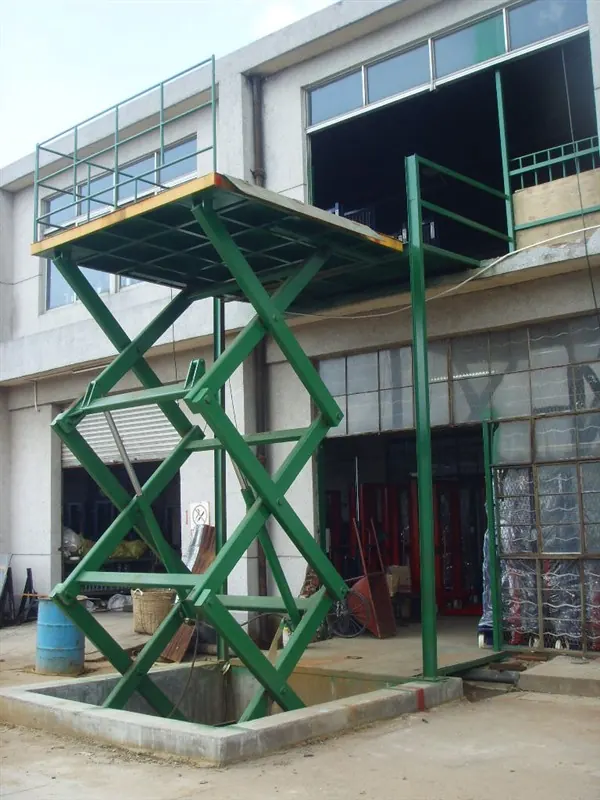
Stationary hydraulic scissor lifts
Typical Applications. Hydraulic scissor lifts cover light-duty material handling through to heavy-load lifting, with heavy-load applications often involving shorter travel. Stationary scissor lifts commonly raise goods to loading platforms or position materials at workstations, while fixed multistage designs provide greater travel for mezzanine or upper-floor access. Mobile hydraulic scissor lift tables support material handling and height adjustment across different work areas.
Guide-Rail Hydraulic Cargo Lifts
Structure and Working Principle. The hydraulic system raises and lowers the cargo platform, while a guide structure directs its vertical movement between fixed loading levels. Depending on the design, supports may be positioned on one side, on opposite sides, or around the platform. Their arrangement shapes the available loading space and the directions from which goods can enter and leave at each level.
Common Support Layouts.
- Single-Post Cantilever: The platform extends from a single mast, leaving the other sides available for entrance arrangements. This layout is commonly used for smaller platforms and lighter loads, such as boxed goods or components moving to a storage mezzanine. Installation planning should account for the mast’s anchoring requirements and the space occupied by the projecting platform.
- Two-Post Cantilever: Two masts support the platform from the same side, allowing same-side, straight-through, or 90-degree loading. This makes the layout useful when loading directions differ between floors. The installation needs sufficient space along the support side for both masts; platform depth and load position are important when specifying capacity.
- Two-Post Straddle: The platform runs between masts on opposite sides, typically with same-side or straight-through loading. This layout is commonly considered for larger platforms and heavier goods where the loading approaches align with the entrances. The clear width between the masts must accommodate the goods and handling equipment.
- Four-Post: Four posts support the platform around its corners, a layout commonly considered for large platforms, bulky goods, and heavy loads. Entrances can be arranged between the posts to suit different loading directions. Post spacing, crossmembers, and enclosure determine the usable openings and the space needed for installation.
Typical Applications. Guide-rail cargo lifts are commonly used to transfer goods between warehouse floors and mezzanines or between factory production and storage levels. Typical tasks include supplying materials to upper floors and moving finished goods to storage or dispatch areas.
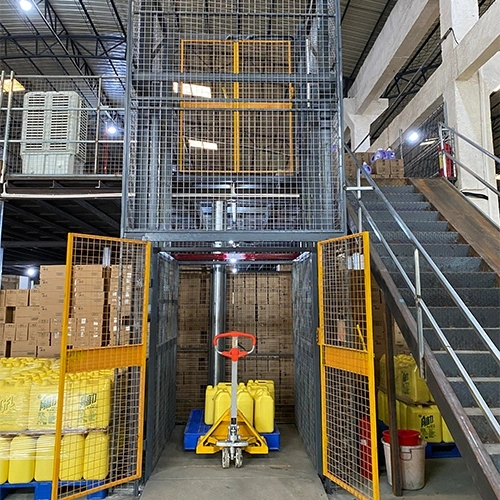
Hydraulic cargo lifts for warehouse and factory handling
Comparing Lifting Structures and Support Layouts
Different designs vary in their support layout, loading access, and space requirements. The table below compares these features alongside common loads and applications. These are common application tendencies; post count alone does not determine capacity.
| Type | Support Layout | Loading and Unloading Pattern | Space Requirements | Typical Loads and Platform Needs | Typical Applications |
|---|---|---|---|---|---|
| Fixed Hydraulic Scissor Lift | Scissor arms beneath the platform; single-stage or multistage | Entrances arranged to suit the platform, guarding, and fixed loading route | Installation space and clearance for the folded mechanism; multistage designs generally have a greater folded height | From light-duty handling to heavy loads on large platforms | Loading-height adjustments, workstation lifting, and mezzanine access with multistage designs |
| Mobile Hydraulic Scissor Lift Table | Scissor mechanism mounted on a wheeled or mobile base | Loading access depends on the platform, handle, and guarding | Clear travel paths, turning space, and room to operate | Commonly cartons, components, and workstation materials | Material handling and height adjustment across different work areas |
| Guide-Rail: Single-Post Cantilever | Platform projects from a single mast | Entrances on sides clear of the mast | Space on one side for the mast and anchoring, plus the projecting platform | Commonly smaller platforms and lighter goods | Boxed goods or components transferred to mezzanines or storage floors |
| Guide-Rail: Two-Post Cantilever | Two masts on the same side | Same-side, straight-through, or 90-degree loading | Space for both masts along one side and clear approaches to entrances | Various goods; platform projection and load position are important | Goods transfer where loading directions differ between floors |
| Guide-Rail: Two-Post Straddle | Platform between opposing masts | Typically same-side or straight-through loading | Mast space on both sides; clear width between them for goods and handling equipment | Commonly pallets, large goods, or heavier loads | Pallet and goods transfer along aligned loading routes |
| Guide-Rail: Four-Post | Supports around the platform’s corners | Entrances between posts, subject to the frame and enclosure | Space for the surrounding frame; post spacing and crossmembers affect entrance clearance | Commonly large platforms, bulky goods, or heavier loads | Large equipment or bulky loads transferred between floors |
By Hydraulic Force Transmission
Hydraulic lifting equipment can also be described by how cylinder movement reaches the platform. Alongside cylinders that operate scissor mechanisms, common arrangements include direct-acting and hydraulic chain drive.
Direct-Acting Hydraulic Lifts
- Working Principle: The hydraulic cylinder acts directly on the platform or its supporting carriage to raise the load.
- Typical Applications: Used for tasks such as raising heavy goods to a loading platform and transferring loads between floors. Short-travel heavy lifting is a common application, while greater travel can be achieved with suitable cylinder designs and installation arrangements.
- Key Characteristics: A direct force-transmission path with no lifting chain. Cylinder stroke, cylinder type, and mounting position influence the lifting travel and installation space.
Hydraulic Chain-Driven Lifts
- Working Principle: The hydraulic cylinder drives a chain-and-sprocket mechanism to raise the platform, allowing platform travel to exceed cylinder stroke.
- Typical Applications: Commonly used where a longer platform travel is required, including transfers between factory or warehouse floors. Multiple stopping levels require suitable controls and landing arrangements.
- Key Characteristics: Greater platform travel can be achieved with a shorter cylinder. The chain mechanism adds inspection and lubrication requirements.
2. Benefits and Suitable Applications of Hydraulic Cargo Lifts
Hydraulic drive offers practical advantages in lifting force and power-unit placement, with potentially competitive installed costs for suitable projects.
Practical Benefits
- High force from compact cylinders: Hydraulic cylinders can generate substantial lifting force within relatively compact dimensions. This is useful when heavy goods need to be raised and space for the lifting mechanism is limited.
- Flexible power-unit placement: Fluid lines connect the power unit to the lifting mechanism, allowing the unit to be positioned separately where the design permits. Its location can be planned around available space, pipe routing, and maintenance access.
- Potentially competitive initial cost: For projects with shorter travel and fewer stopping levels, a hydraulic solution may offer a competitive installed cost. The comparison should include the equipment, building work, and required configuration.
When Is It a Good Fit?
Hydraulic cargo lifts are worth considering for tasks such as moving loaded pallets to a warehouse mezzanine, transferring goods between factory floors, or raising heavy goods to a loading platform. Shorter travel, fewer stopping levels, and a need for substantial lifting force can make hydraulic drive a practical option.
These tasks may involve occasional deliveries, batch replenishment, or frequent transfers throughout a shift. For frequent use, the hydraulic system should be specified for the required lifting speed and number of cycles per hour.
3. Choosing a Hydraulic Cargo Lift
Start with the goods and handling route, then check the site conditions and confirm a configuration that matches the daily workload. For a more detailed checklist, see our hydraulic cargo lift selection guide.
Define the Handling Requirements
Identify the maximum load weight and dimensions, including any pallet jack or trolley that will travel on the platform. Specify the loading levels, lifting height, and trips required during normal and peak operation. For mobile equipment, identify the work areas and the lifting height needed at each workstation.
Check the Site and Installation Conditions
Confirm the installation location, loading directions, and the width and height available for goods to pass through each entrance. Allow enough approach space for handling equipment. Check how the lift will be supported and secured; if the platform will pass through a floor, also confirm the opening requirements.
Outdoor installations need provision for weather exposure and drainage. Mobile equipment needs suitable floor surfaces, clear travel paths, and turning space. See our hydraulic lift installation guide for an overview of site preparation and power requirements.
Confirm the Equipment Configuration
Review the proposed lifting structure, support layout, and hydraulic force-transmission arrangement against your handling and site requirements. Confirm the rated capacity, platform dimensions, and lifting height, together with the usable platform space and entrance arrangement. Match the operating speed and duty cycle to the expected workload, and agree on site preparation, power supply, and maintenance access before installation.
Project Example: Moving Large Curtain-Wall Components
Guangdong Keteng needed to move large glass panels and aluminum components between workshop floors. The goods were bulky and heavy, and transfers were a frequent part of daily production.
We supplied eight fixed hydraulic lifting platforms, each with an 8 m × 3.5 m platform, a 10-tonne rated capacity, and a 15 m lifting height. The large platform accommodates the components, while the capacity and travel address the weight and vertical transfer requirements. Hydraulic drive works with a rigid guide-rail system to guide the platform between floors.
After installation, components could be loaded once and delivered directly to the receiving floor, reducing intermediate unloading and reloading. The arrangement also reduced repeated forklift trips and simplified the movement of large components through the workshop. View the project case.
Conclusion
The different types of hydraulic cargo lifts serve tasks ranging from workstation handling to floor-to-floor goods transfer. Scissor and guide-rail types differ in their lifting and guiding structures, while direct-acting and hydraulic chain-driven types differ in how cylinder movement reaches the platform. These distinctions explain their differences in platform layout, lifting travel, installation space, and common applications.
Share your handling needs and site measurements with Weilin Qinli to discuss a custom hydraulic cargo lift solution and receive a project proposal and quotation.